 Rarible
 combines NFT trading with tokenized physical collectibles
Rarible combines multichain NFT trading with tokenized physical collectibles, whose blockchain tokens represent ownership of items held in a vault. An NFT is a non-fungible token: a blockchain record that identifies a particular asset within a collection. The marketplace brings together listings for buying and selling, including listings gathered from other venues. Digital collectibles remain part of the platform alongside graded physical items and its Gacha pack-opening experience. The available chain, payment method, and purchase format determine how each trade works. A direct listing identifies the item before purchase, while a pack reveals its particular collectible during opening.
A tokenized collectible can change hands onchain while its physical item stays in a vault under separate redemption conditions.
Wallets, listings, and marketplace infrastructure
Wallets authorize transactions, listings describe available trades, and indexed data makes those listings searchable. Token contracts record ownership, while Rarible’s wallet-connected trading leaves funds and NFTs under the wallet owner’s control.
The Rarible API supplies developers with indexed NFT items, collections, metadata, and trading activity. Its aggregated order book brings together listings from multiple marketplaces, while its trading SDK supports minting, sales, and purchases. The API helps an application display and prepare trades; the relevant blockchain contracts execute asset transfers. The indexed data also supports NFT analytics applications beyond marketplace trading. Collection statistics include floor prices, sales counts, and trading volume. Floor prices concern asking prices on available listings; sales counts and volume describe executed trades during the selected reporting period.
How do NFT purchases and sales settle?
NFT purchases and sales settle through blockchain transactions that transfer the token and payment under the applicable order and contract rules. A fixed-price listing identifies an item and asking price. An active collection offer provides another selling path: an eligible holder can accept that offer without creating a separate sale listing. The order must remain valid when the trade executes.
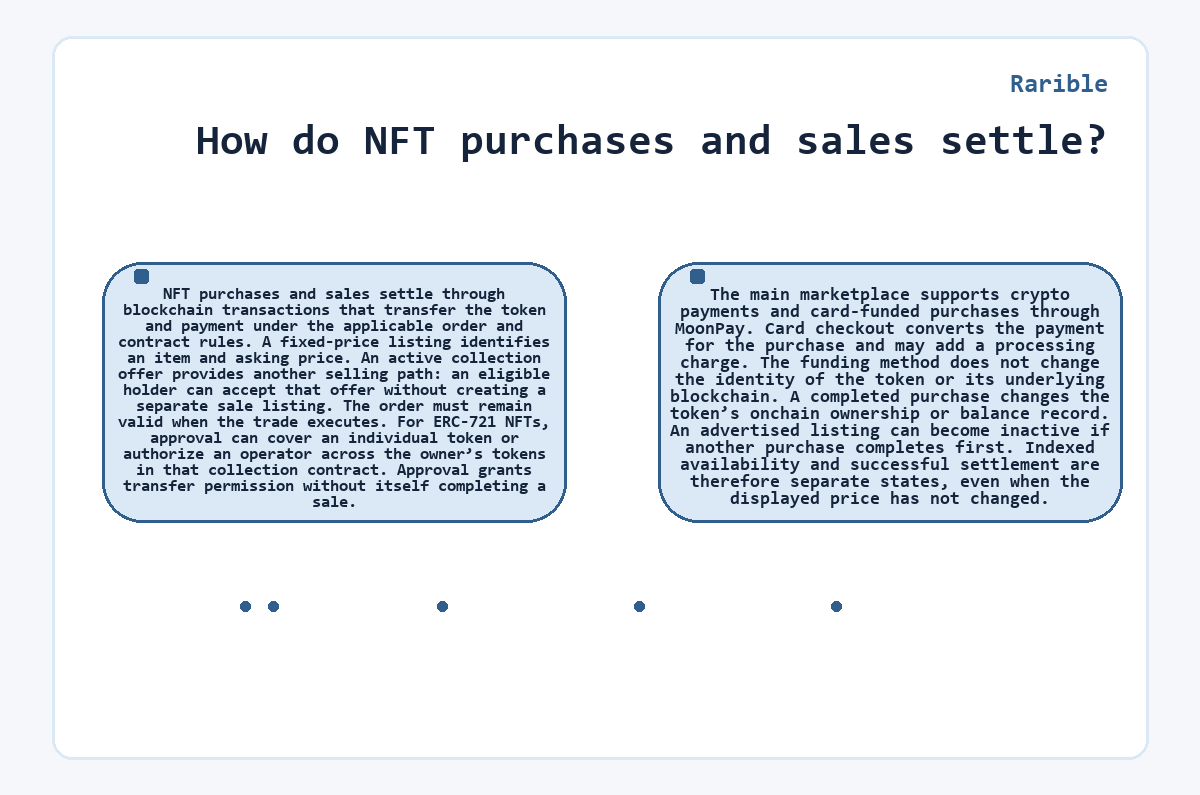
For ERC-721 NFTs, approval can cover an individual token or authorize an operator across the owner’s tokens in that collection contract. Approval grants transfer permission without itself completing a sale.
The main marketplace supports crypto payments and card-funded purchases through MoonPay. Card checkout converts the payment for the purchase and may add a processing charge. The funding method does not change the identity of the token or its underlying blockchain. A completed purchase changes the token’s onchain ownership or balance record.
An advertised listing can become inactive if another purchase completes first. Indexed availability and successful settlement are therefore separate states, even when the displayed price has not changed.
What backs a tokenized physical collectible?
Tokenized physical collectibles represent items held by a marketplace or vault provider, with grading and provenance details identifying the stored collectible. Collector Crypt connects physical cards to their onchain counterparts, while Rarible supplies discovery and trading infrastructure. For Collector Crypt-backed cards, each token maps to one physical card held in storage. Token trading changes the recorded ownership while the card remains vaulted.
The vault provider retains physical custody. A non-custodial wallet transaction describes control of the digital asset; it does not place the stored card in the buyer’s possession.
Physical delivery requires a separate redemption option. Shipping was not included in the marketplace launch described in Rarible’s September 2026 FAQ, and planned redemption excluded some destinations. A tradable token therefore does not promise immediate delivery. The item’s grading certificate, storage arrangement, and applicable delivery conditions concern the physical collectible, even when its ownership changes onchain.
What determines the total trading cost?
Trading costs combine the applicable marketplace charge, creator royalties, network gas, and any payment-processing fee; the listing’s origin determines which marketplace charges apply. The September 2026 fee schedule sets a seller marketplace fee of 2% of the sale price for native listings on Ethereum, Base, and Polygon. Native Solana listings carry a 1.5% seller marketplace fee. Other supported chains have their own displayed charges.
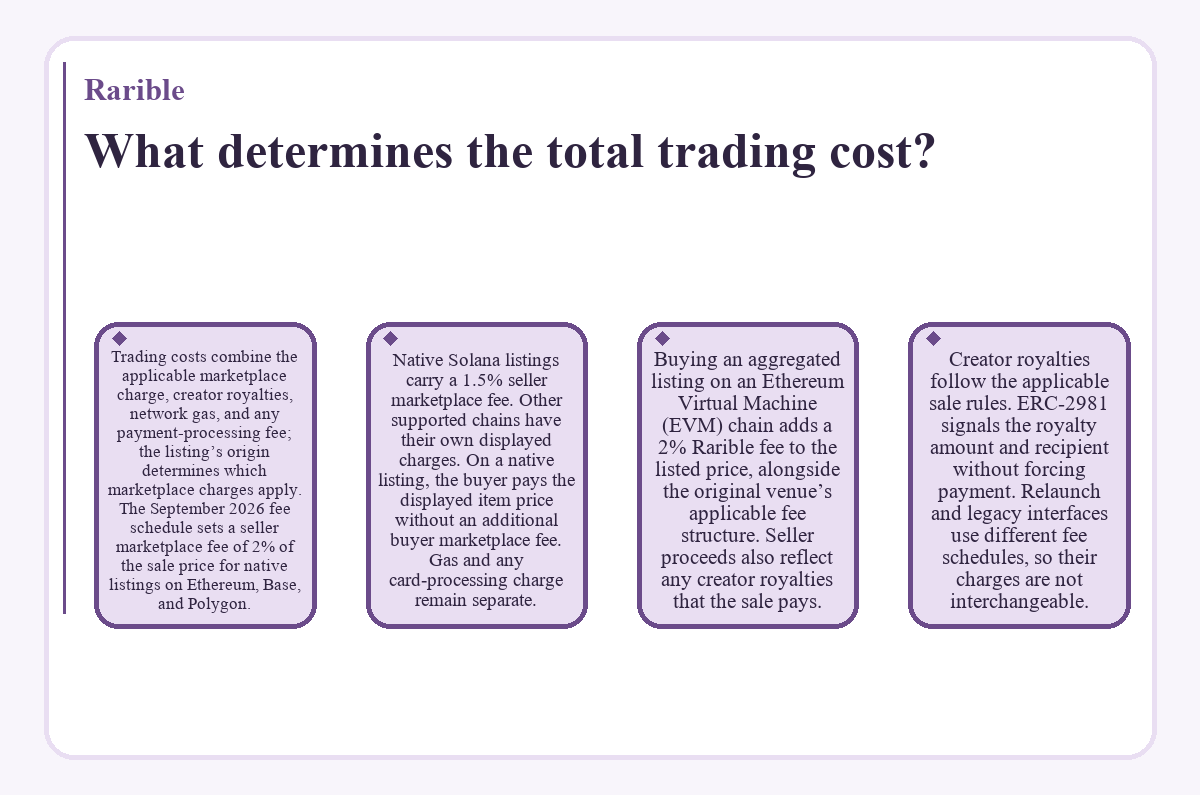
On a native listing, the buyer pays the displayed item price without an additional buyer marketplace fee. Gas and any card-processing charge remain separate. Buying an aggregated listing on an Ethereum Virtual Machine (EVM) chain adds a 2% Rarible fee to the listed price, alongside the original venue’s applicable fee structure. Seller proceeds also reflect any creator royalties that the sale pays.
Creator royalties follow the applicable sale rules. ERC-2981 signals the royalty amount and recipient without forcing payment. Relaunch and legacy interfaces use different fee schedules, so their charges are not interchangeable.
Minting, collections, and creator controls
Rarible’s legacy creator tools support NFT creation within a pre-deployed collection or a collection that the creator establishes. Minting creates the blockchain token and associates it with descriptive metadata. Collection choice determines how the work is grouped and which contract records its ownership. Creating a token also requires rights to the content being published; uploading a file does not establish those rights.
The Ethereum-style collection tools distinguish ERC-721 single NFTs from ERC-1155 editions. ERC-721 identifies each token individually, while ERC-1155 can record multiple units under a token ID. An edition’s token supply comes from the contract’s records, independently of how many copies of the associated media exist.
In the legacy Ethereum lazy-minting flow, the NFT is minted onchain at the time of purchase. The creator signs a minting authorization, and the buyer pays the minting gas when purchasing. Deferring minting moves that network cost to the later purchase; it does not eliminate the cost. Before onchain minting, the marketplace listing and the blockchain token record are different things.
Creator controls also include royalty settings and unlockable content. In the legacy Ethereum creation flow, unlockable content gives purchasers access to additional content through the marketplace. That platform-hosted content does not automatically appear on other marketplaces. Community marketplaces provide collection-specific storefronts with configurable community fees routed to a designated wallet.
Listed items and Gacha packs
A listed NFT or vaulted card identifies the item before purchase, while Gacha Station sells packs that reveal particular collectibles during opening. Gacha Station is available on Solana and uses USDC for pack purchases. Series pages display pack tiers, recent pulls, and top items available in the machine. Displaying a desirable card does not promise that a particular pack will contain it.
| Purchase format | What it provides | Purchase limitation |
|---|---|---|
| Listed NFT | A specified blockchain token at the available listing price | The listing can become inactive before settlement |
| Listed vaulted collectible | A token representing an identified stored physical item | Token ownership alone does not arrange physical delivery |
| Gacha pack | A collectible selected through the pack-opening mechanism | The buyer cannot select a particular pull as with a direct listing |
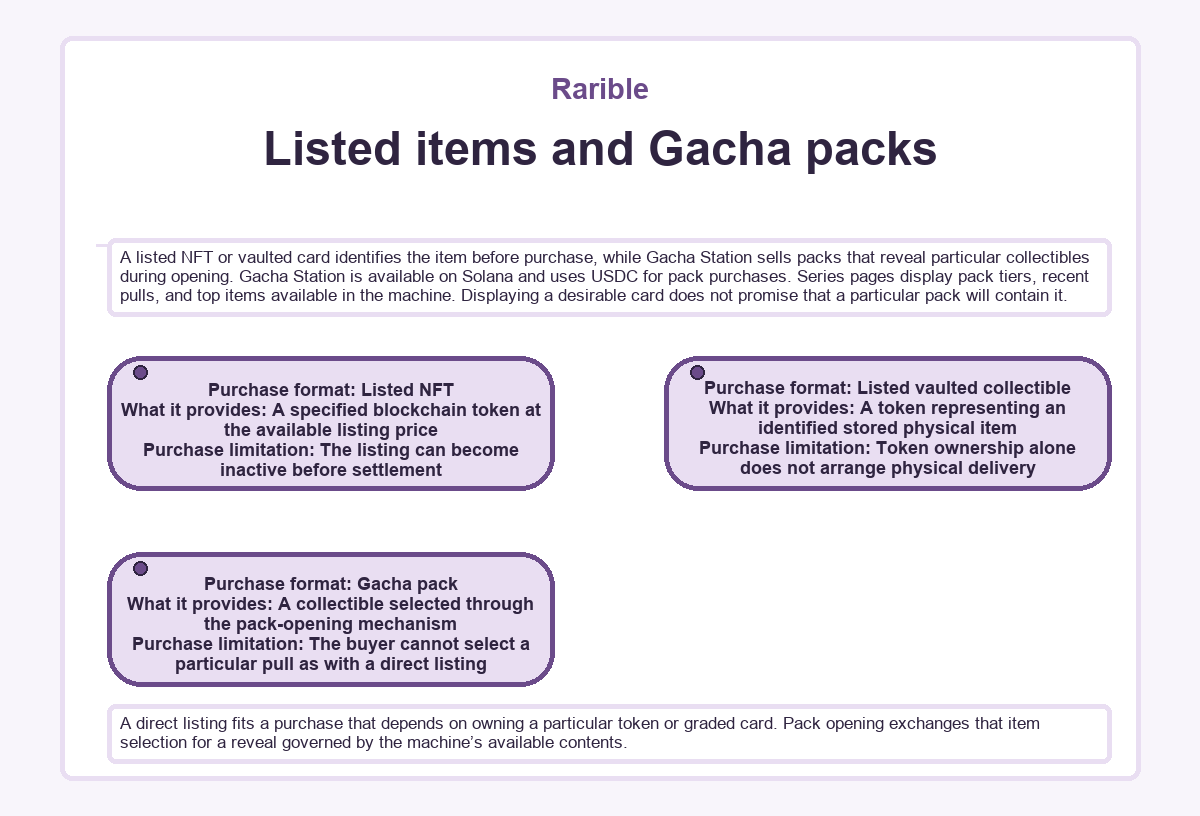
Listed items and Gacha packs
A listed NFT or vaulted card identifies the item before purchase, while Gacha Station sells packs that reveal particular collectibles during opening. Gacha Station is available on Solana and uses USDC for pack purchases. Series pages display pack tiers, recent pulls, and top items available in the machine. Displaying a desirable card does not promise that a particular pack will contain it.
- Purchase format: Listed NFT What it provides: A specified blockchain token at the available listing price Purchase limitation: The listing can become inactive before settlement
- Purchase format: Listed vaulted collectible What it provides: A token representing an identified stored physical item Purchase limitation: Token ownership alone does not arrange physical delivery
- Purchase format: Gacha pack What it provides: A collectible selected through the pack-opening mechanism Purchase limitation: The buyer cannot select a particular pull as with a direct listing
A direct listing fits a purchase that depends on owning a particular token or graded card. Pack opening exchanges that item selection for a reveal governed by the machine’s available contents.
A direct listing fits a purchase that depends on owning a particular token or graded card. Pack opening exchanges that item selection for a reveal governed by the machine’s available contents.
Things people ask
Does owning RARI give control over the current marketplace?
Owning RARI does not establish control over the current Rarible marketplace. The marketplace’s brand and key platform assets changed ownership, while the RARI token and broader RARI Foundation ecosystem remain independently managed and governed.
Who is eligible to use Rarible?
Rarible’s terms require users to be at least 18 and to have reached the age of majority in their jurisdiction. Access also depends on applicable law, sanctions restrictions, and account status. Meeting the age requirement alone does not establish eligibility to use the marketplace from every location.
Why does a purchase fail when my wallet has enough funds?
A purchase can fail because the contract rejects the payment or transaction, even when the wallet has sufficient total value. An unsupported payment token, insufficient gas, or a collection-specific contract restriction can prevent execution. The wallet’s displayed balance therefore does not establish that it can satisfy that particular order.
Does buying an NFT transfer copyright in its artwork?
Buying an NFT does not automatically transfer copyright in the artwork that it represents. Creators retain their rights unless separate terms grant or transfer them. Token ownership and permission to reproduce or commercially use the media are distinct; any content license determines the rights that accompany the purchase.
Are NFT images guaranteed to remain available onchain?
An NFT’s ownership record can exist onchain while its image and metadata are stored elsewhere. ERC-721 allows metadata to point to external resources and permits mutable metadata addresses. Media availability therefore depends on the particular collection’s storage and contract design, independently of the continuing token record.
How can I distinguish NFT collections that share a name?
For ERC-721 collections, the blockchain and contract address distinguish collections that reuse the same name. Adding the token ID identifies a particular NFT within that contract. Names and symbols are not unique identifiers enforced by the standard, so a matching display label alone does not establish the intended collection.
Can a Gacha gift go to a wallet on another blockchain?
The July 2026 Gacha gifting flow supports recipient addresses on Solana only. A wallet address from another blockchain does not satisfy that route’s destination requirement. Gifts use the recipient’s Solana address, and confirmed gift transfers cannot be reversed, making the destination address a material part of the gift.
When does a Gacha buyback offer expire?
Gacha buyback offers in the July 2026 flow expire 72 hours after the result dialog opens. Eligible Common cards with Instant Buyback enabled are processed automatically instead of following the manual offer path. Accepting a manual buyback provides credit toward another pack; the displayed market value is a separate figure.