 Rarible
 unlockable content reveals hidden material after an Ethereum NFT purchase
Rarible unlockable content lets buyers access hidden material attached to an Ethereum NFT after purchase in the legacy marketplace. Creators add it during minting. Rarible hosts the hidden material separately from the blockchain token, so an NFT can appear elsewhere without its unlockable.
The short version: An NFT ownership record cannot make a broken download work; hidden material needs a functioning access path.
A purchase with usable hidden material
Buying an NFT for its hidden material requires access to the promised content after the sale. Before approving payment, establish what the listing offers and whether any access conditions change that promise. Token ownership and delivery of the advertised material are separate outcomes.
- Confirm that the NFT is on Ethereum and that its listing identifies the hidden material included with purchase.
- Connect a supported wallet with funds for the purchase and applicable transaction costs.
- Read any download, membership, or usage conditions before committing to the purchase.
- After the sale completes, check that the NFT appears under Owned in the purchasing profile and that its hidden material is accessible.
- Check any revealed destination separately: the purchase record does not establish that a download or invitation works.
If the token arrives but the promised material remains inaccessible, the hidden-content part of the purchase remains unresolved.
Ethereum support and marketplace visibility
Ethereum support applies specifically to this legacy unlockable-content feature. Rarible’s broader multichain marketplace has a wider trading scope. Selecting an Ethereum-compatible wallet does not extend the feature to every network that the wallet supports. The blockchain where the NFT exists matters independently of the sign-in option.
An NFT minted through Rarible can appear on other marketplaces that index its collection. Rarible-hosted unlockable content does not appear on other marketplaces. Those marketplaces can display the token and its public information without providing the hidden material. A missing unlockable there does not, by itself, establish that the NFT lacks one.
The token record and the linked material
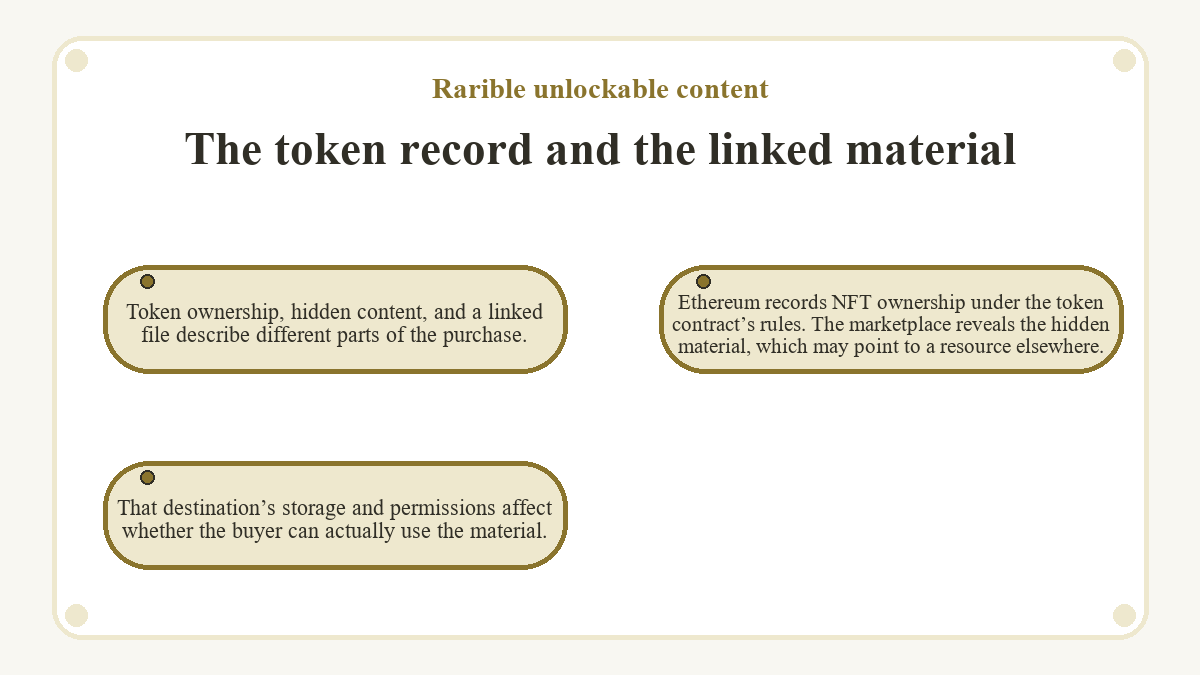
Token ownership, hidden content, and a linked file describe different parts of the purchase. Ethereum records NFT ownership under the token contract’s rules. The marketplace reveals the hidden material, which may point to a resource elsewhere. That destination’s storage and permissions affect whether the buyer can actually use the material.
Public metadata and private content
Public metadata supplies information such as an NFT’s name, description, and artwork reference. Hidden material has its own access requirements. A public image displaying correctly says little about the availability of a private download. Likewise, an artwork-loading error does not establish that a purchase failed when the blockchain record already shows the buyer’s ownership.
File hosting and continued availability
An external download relies on the server or storage system that holds the file. Rarible’s public NFT-storage integration announced in July 2022 used IPFS, the InterPlanetary File System, and Filecoin. That arrangement does not establish the storage location of an individual unlockable. Ordinary web links can stop working if their host disappears or changes the resource. An NFT ownership record cannot repair that failure.
Creators who promise ongoing file access need to maintain the relevant hosting and permissions.
Creator preparation before minting
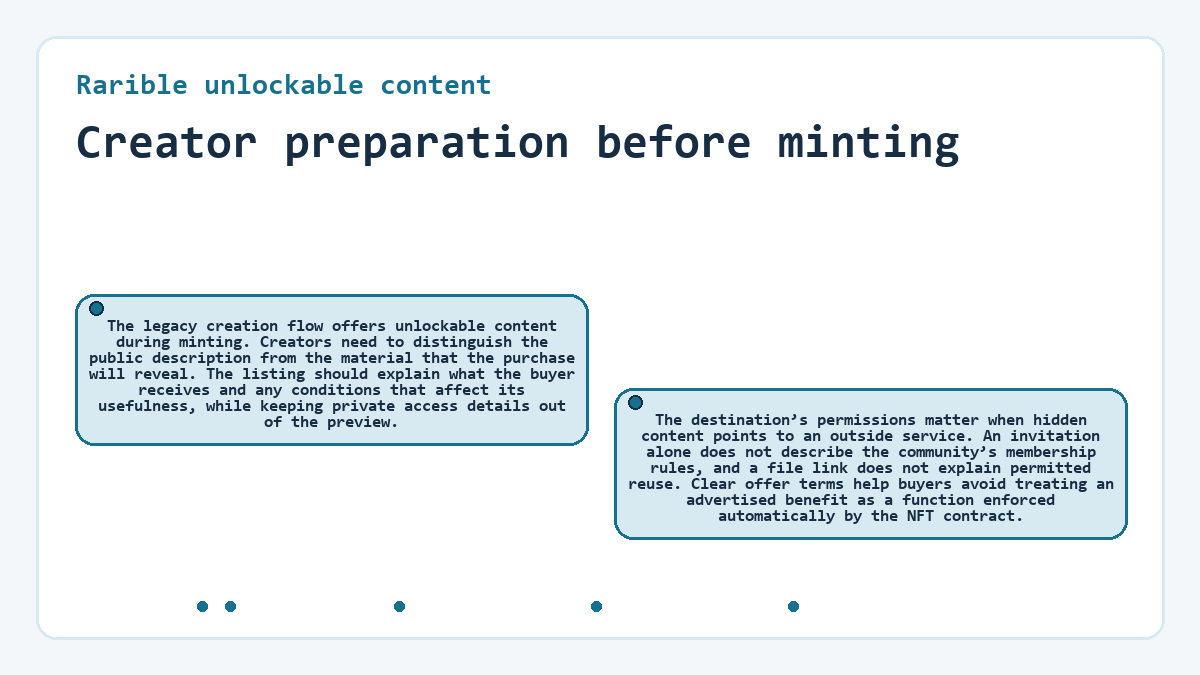
The legacy creation flow offers unlockable content during minting. Creators need to distinguish the public description from the material that the purchase will reveal. The listing should explain what the buyer receives and any conditions that affect its usefulness, while keeping private access details out of the preview.
The destination’s permissions matter when hidden content points to an outside service. An invitation alone does not describe the community’s membership rules, and a file link does not explain permitted reuse. Clear offer terms help buyers avoid treating an advertised benefit as a function enforced automatically by the NFT contract.
Access failures and the affected component
An access failure may involve the connected wallet, the browser, Rarible’s item display, or the destination that holds the material.
Wallet and browser problems
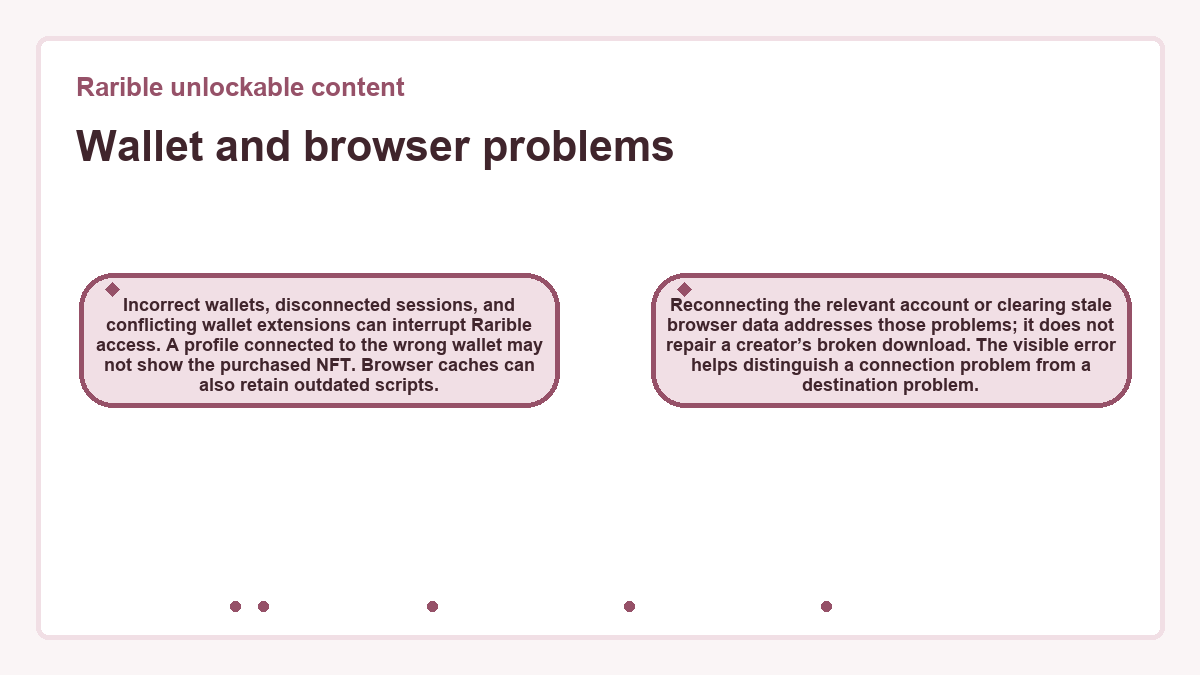
Incorrect wallets, disconnected sessions, and conflicting wallet extensions can interrupt Rarible access. A profile connected to the wrong wallet may not show the purchased NFT. Browser caches can also retain outdated scripts. Reconnecting the relevant account or clearing stale browser data addresses those problems; it does not repair a creator’s broken download. The visible error helps distinguish a connection problem from a destination problem.
Broken files and invitations
A missing file, a denied download, and an unusable invitation involve different destination problems. A creator may need to replace an obsolete link or adjust its access permissions. Describe the actual error when asking for help. A transaction hash identifies the blockchain purchase, while an error message identifies the content-access problem. Neither establishes that the other part is working.
Requests at a revealed destination deserve separate scrutiny. Opening a file or following a community invitation does not require disclosing a wallet recovery phrase. A destination that asks for token-spending approval introduces a separate wallet action. Inspect that request before signing, even when the link appeared in hidden material from a purchased NFT.
Hidden artwork, music, and collector communities
The feature can reveal hidden artwork, a link to an unreleased song, or a link to a private collector community. An artwork reveal concerns the image itself, while a song link points to the recording. A community invitation provides a way to enter a space governed by its own participation rules.
Community access also involves the information that members share with the service. When the promised benefit includes an outside service, that service’s access rules help determine what the purchase delivers.
Quick answers about Rarible unlockable content
-
Can Rarible unlockable content guarantee that a revealed link stays secret?
- A revealed link can be copied by someone who can read it. Secrecy after disclosure also depends on what recipients do with the link and how its destination controls access. Hiding a link before purchase cannot ensure that every buyer keeps it private, so a creator should distinguish restricted disclosure from lasting confidentiality.
-
Will refreshing an NFT’s metadata restore a missing unlockable file?
- Refreshing metadata cannot restore a file that is missing from its external host. A refresh updates the information that Rarible displays about the NFT; it does not repair the file server or its permissions.
-
What information helps support investigate missing Rarible unlockable content?
- Useful support details identify both the NFT and the content-access failure. Include the blockchain, contract address, token ID, connected wallet address, and purchase transaction hash if available. Explain whether the hidden material is absent or a revealed destination fails, and include relevant error messages or screenshots. Keep recovery phrases and private keys out of the request.
-
Is an NFT report suitable for an unlockable-content access bug?
- A general content-access bug belongs in a support request. Rarible’s item-reporting function handles concerns such as scams, impersonation, and copyright infringement. Suspected malicious content may justify an item report, while an ordinary loading error calls for technical assistance.
-
What happens to hidden-content access if Rarible removes the NFT from view?
- Removal from Rarible’s display does not itself erase ownership of the blockchain token. The NFT can remain in its owner’s wallet while the marketplace restricts its display. Continued ownership does not establish that the hidden material remains reachable through Rarible. An access complaint should identify whether the item page has been removed.
-
May I repost an unreleased song revealed by a Rarible NFT?
- Revealing a song does not by itself grant permission to publish or redistribute the recording. The creator’s license or agreement determines permitted uses. Listening access, a download, and permission to republish describe different rights; access to the recording alone does not establish that the buyer received all of them.
-
Does a verified Rarible collection guarantee that its unlockable works?
- Collection verification does not establish that a particular hidden file or invitation is available. The promise attached to the item still needs a usable access path, and verification alone does not establish the availability or quality of that promised material.