 Rarible
 supports ERC-721 NFTs and ERC-1155 editions with different ownership models
Rarible supports ERC-721 and ERC-1155 NFTs from collections on Ethereum Virtual Machine (EVM)-compatible blockchains. ERC-721 records a single onchain owner for each existing token ID. ERC-1155 tracks quantities under each ID, allowing several addresses to hold copies of the same item. The distinction is separately identifiable tokens versus interchangeable units within an edition. Either collection type can contain many items, and an ERC-1155 item can also have a supply of one.
Key takeaway: A single-copy ERC-1155 item still uses edition balances, so supply alone does not identify an NFT’s token standard.
How do Single and Multiple differ on Rarible?
Rarible’s legacy EVM creation flow maps Single to ERC-721 and Multiple to ERC-1155. Single creates an individually identified token, while Multiple supports an item with a creator-selected edition quantity. These labels belong to that creation interface; they do not describe every blockchain or every collection that the broader marketplace can display. The collection’s implemented standard determines its ownership model, even when a listing uses less technical language.
Separately issued ERC-721 tokens retain separate IDs even when their artwork matches, while units of the same ERC-1155 ID share a token identity, with each address holding its own quantity. Choosing Single does not establish that the creator has never issued the same image elsewhere, or that the entire collection contains only one NFT.
Token identity and edition balances
A token’s identity includes its blockchain, contract address, and token ID. An ID is unique within its contract’s scope, rather than across every collection. The contract supplies the rules for interpreting that identifier. Ownership queries then answer different questions under the two standards, which matters when a marketplace shows an item, its holders, or a wallet’s collection balance.
Individually tracked ownership
ERC-721 records an owner for each existing token ID. Its ownerOf function identifies that address, while balanceOf counts how many tokens an address owns in the collection. A wallet holding several tokens has separate ownership records, even when those tokens use matching media.
ERC-1155 balance records
Units held by an address
ERC-1155 queries a balance using both an address and a token ID, returning the units that address holds of that type. Several holders can have positive balances for the same ID, and a holder can own several copies. The balance does not assign an individual serial number to each unit.
Different IDs within a contract
An ERC-1155 contract can contain different token IDs with different metadata and supplies. Interchangeability applies to units of the same type, not automatically to everything in the contract. A collection’s total number of IDs, an item’s issued supply, and an address’s holding describe different quantities.
Can ERC-1155 represent a single-edition NFT?
An ERC-1155 token ID can have a supply of one. That configuration still uses ERC-1155 balance accounting. The standard does not require multiple copies merely because a marketplace calls its creation option Multiple. Conversely, a collection containing many ERC-721 tokens still gives each token its own identity. Supply and token standard answer different classification questions.
Current supply differs from a permanent issuance limit: a single unit in circulation does not establish that future minting is impossible. Rarible’s legacy Multiple creation flow lets the creator specify an edition quantity, while existing contracts govern issuance through their own minting rules. A fixed edition requires a corresponding limit in the applicable contract or issuance mechanism; the ERC-1155 label alone supplies no universal cap.
Shared collections and creator-owned contracts
Collection choice is separate from token type in the legacy creation flow, which offers pre-deployed collections for single tokens and multiple editions alongside the option to create a collection. A shared contract can contain work from multiple creators, whereas a creator-owned collection places the work under its own contract address. Both arrangements still require the appropriate token interface for the items being issued.
ERC-721 permits many distinct tokens within one collection, so each artwork does not need a separate deployment. ERC-1155 likewise groups different IDs within one contract. Creating a new collection incurs blockchain deployment costs in the applicable flow; using an existing collection avoids that particular deployment. This distinction concerns contract creation costs, rather than a fixed price difference between every ERC-721 and ERC-1155 mint.
The same artwork under separate IDs or a shared ID
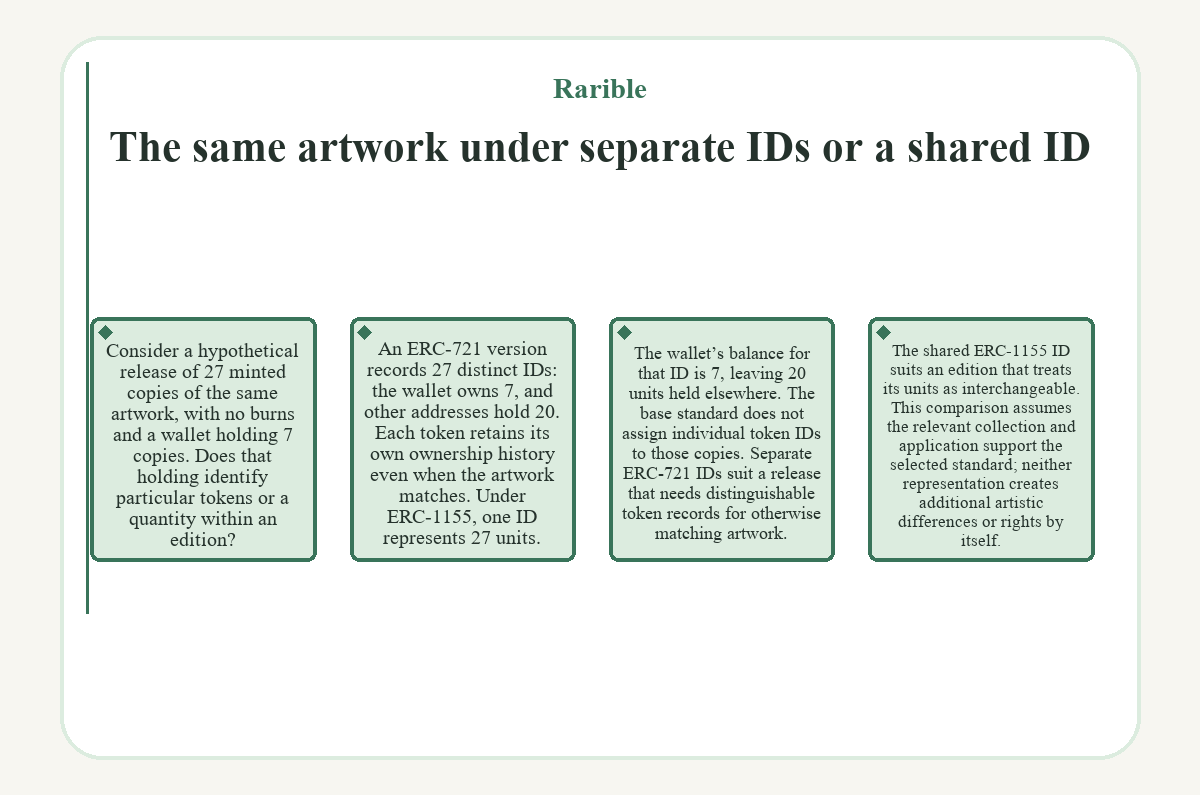
Consider a hypothetical release of 27 minted copies of the same artwork, with no burns and a wallet holding 7 copies. Does that holding identify particular tokens or a quantity within an edition?
An ERC-721 version records 27 distinct IDs: the wallet owns 7, and other addresses hold 20. Each token retains its own ownership history even when the artwork matches.
Under ERC-1155, one ID represents 27 units. The wallet’s balance for that ID is 7, leaving 20 units held elsewhere. The base standard does not assign individual token IDs to those copies.
Separate ERC-721 IDs suit a release that needs distinguishable token records for otherwise matching artwork. The shared ERC-1155 ID suits an edition that treats its units as interchangeable. This comparison assumes the relevant collection and application support the selected standard; neither representation creates additional artistic differences or rights by itself.
Metadata and matching artwork
Metadata supplies the name, description, and media reference that a marketplace displays. ERC-721 commonly exposes a metadata address through tokenURI, while ERC-1155 uses uri when its optional metadata extension is present. These fields describe the asset, while ownership or edition balances remain part of the token contract’s state. Distinct ERC-721 IDs do not require distinct image files, and shared artwork does not establish a shared token identity.
Units under one ERC-1155 ID use that ID’s metadata, while different IDs can describe different assets. Metadata references can point to separately stored files because neither standard requires all media to reside onchain. The implementation determines whether a reference can change. The edition count therefore says nothing by itself about media storage or permanence.
Transfer amounts and authorization
ERC-721 transfers identify the token being moved, while ERC-1155 transfers specify a token ID and an amount. An ERC-1155 amount determines how many units move and cannot exceed the sender’s available balance for that ID.
Permission to move tokens
ERC-721 supports approval for an individual token and approval for an operator across the owner’s tokens in a contract. ERC-1155’s base approval interface authorizes an operator across the owner’s tokens in that contract. A request concerning an edition can therefore grant permission beyond that particular item. Additional restrictions require implementation-specific functionality; they are not inherent per-item limits in the base ERC-1155 approval.
Acceptance by recipient contracts
Safe transfers to a smart contract require compatible recipient handling. Ordinary single-standard implementations use the relevant receiver callback to confirm acceptance; rejection makes the transfer revert. A recipient that handles ERC-721 does not automatically handle ERC-1155. These checks concern the receiving contract’s capabilities, so an address’s ability to receive payment does not establish that it can receive either NFT type.
Batch transfers and transaction costs
ERC-1155 includes a batch-transfer function that combines balance updates for multiple IDs and amounts between the same sender and recipient. ERC-721’s base interface specifies individual-token transfers, without an equivalent standardized batch function. Additional contract or application logic can coordinate multiple operations. The standard’s interface therefore does not impose a universal transaction count for every collection or marketplace operation.
Batching can reduce repeated transaction overhead, but actual costs follow the operations performed and the network’s fee rules. On Ethereum, gas used and the effective gas price determine the execution fee. Deployment, minting, approvals, and trading perform different work, and some networks have additional fee components. A meaningful comparison needs the same task, chain, and relevant contract behavior. Neither standard fixes a marketplace’s charges or guarantees a cheaper transaction.
The limits of token-type classification
A token standard describes ownership accounting and transfer interfaces; issuance rules determine whether a release has a fixed supply. Artistic uniqueness, collector demand, and edition value are separate properties. These EVM standards also do not classify every native NFT format across a multichain marketplace.
Royalties and unlockable content have separate mechanisms and support conditions. The basic ERC-721 and ERC-1155 interfaces neither require private-content delivery nor enforce creator payments on every resale. An edition’s accounting model cannot establish whether an attachment remains accessible elsewhere or whether a particular resale pays a royalty.
What to know about Rarible
Can I switch a minted NFT from ERC-721 to ERC-1155 by editing its listing?
Editing a listing does not change the token standard implemented by its contract. A separately minted representation under another contract has a different token identity, even when it uses the same artwork. Listing details describe a sale; they do not rewrite the original token’s ownership interface.
Do ERC-1155 edition copies represent fractions of an ERC-721 NFT?
An ERC-1155 edition balance does not inherently represent fractional ownership of an ERC-721 NFT. It records units under its own contract and token ID. A connection to another asset requires a separate mechanism; sharing an image or edition name does not create that connection.
Are ERC-721 token IDs always consecutive numbers?
ERC-721 token IDs do not have to be consecutive. Contracts can assign identifiers without following a visible counting pattern. A high token ID therefore does not establish the collection’s size, and a missing number does not prove that an NFT was burned. Supply must be determined separately.
What does burning an ERC-1155 edition copy change?
Burning a minted ERC-1155 edition unit reduces its holder’s balance and the circulating supply for that ID by one. Other copies can remain in circulation. Whether additional units can later be minted depends on the contract’s issuance rules, so a burn does not automatically establish a permanent maximum supply.
Is batch minting required for every ERC-1155 collection?
ERC-1155 does not require a public batch-minting function. Its standardized batch-transfer capability concerns moving existing balances. Minting entry points and access rules belong to each implementation. Support in a contract also does not establish that a particular Rarible creation interface exposes a batch-minting option.
How can a contract report whether it supports ERC-721 or ERC-1155?
A compliant token contract reports its supported interfaces through ERC-165. Its supportsInterface function can indicate support for ERC-721 or ERC-1155. This identifies an implemented interface; it does not certify the artwork, supply restrictions, or marketplace compatibility. A custom contract may implement more than one interface.